
COMPLETE GUIDE TO LAND DOCUMENTATION IN NIGERIA
COMPLETE GUIDE TO LAND DOCUMENTATION IN NIGERIA
Paying for land does not automatically make you its legally protected owner.
In Nigeria, a buyer can possess a payment receipt, take physical possession of a property, and even begin construction, yet still face ownership disputes if the seller’s title was defective or the transfer was not properly documented.
Proper land documentation in Nigeria must establish four important facts:
The person selling the land has a valid interest in it.
The land being sold is clearly identified.
The seller has the legal authority to transfer the property.
The buyer’s interest has been properly documented and, where required, perfected at the appropriate land registry.
The Land Use Act provides the foundation of Nigeria’s land administration system. It vests land within each state in the Governor, to be held in trust and administered for the use and common benefit of Nigerians.
Urban land is generally administered by state governments, while certain non-urban land falls under local government administration. (Laws of Nigeria)
This means that land transactions in Nigeria are not protected by payment receipts and verbal assurances alone. Buyers must understand the difference between land title, transaction documents, survey documents and title-perfection documents.
What Is Land Documentation?
Land documentation refers to the legal, administrative and technical records that identify a property, establish its ownership history and record the transfer of an interest from one person to another.
A complete land documentation file should show:
The original source or root of the seller’s title
Every significant transfer in the property’s ownership history
The exact location, dimensions and boundaries of the property
Evidence of payment and the terms of the transaction
Government consent, stamping and registration where applicable
Evidence that the property is not under acquisition, litigation, mortgage or another encumbrance
Land documents do not necessarily perform the same function. A survey plan identifies the land, a receipt proves that money was paid, and a Deed of Assignment records the transfer of an interest.
One document should not automatically be treated as a substitute for another. (Asabe Waziri Justice Advocacy Initiative)
Land Title Versus Land Documents: What Is the Difference?
A land title represents the legal interest a person holds in a property. It answers the question: What right does this person have over the land?
A land document is the physical or electronic record used to prove, describe, transfer or perfect that interest.
For example:
A Certificate of Occupancy evidences a right of occupancy granted or recognised by the government.
A Deed of Assignment records a transfer from an assignor to an assignee.
A survey plan identifies the exact parcel being discussed.
A purchase receipt confirms payment.
Governor’s Consent signifies government consent to the transfer of a statutory right of occupancy where required.
A serious property investigation must examine the documents together rather than relying on one impressive-looking certificate.
Essential Land Documents in Nigeria
1. Certificate of Occupancy
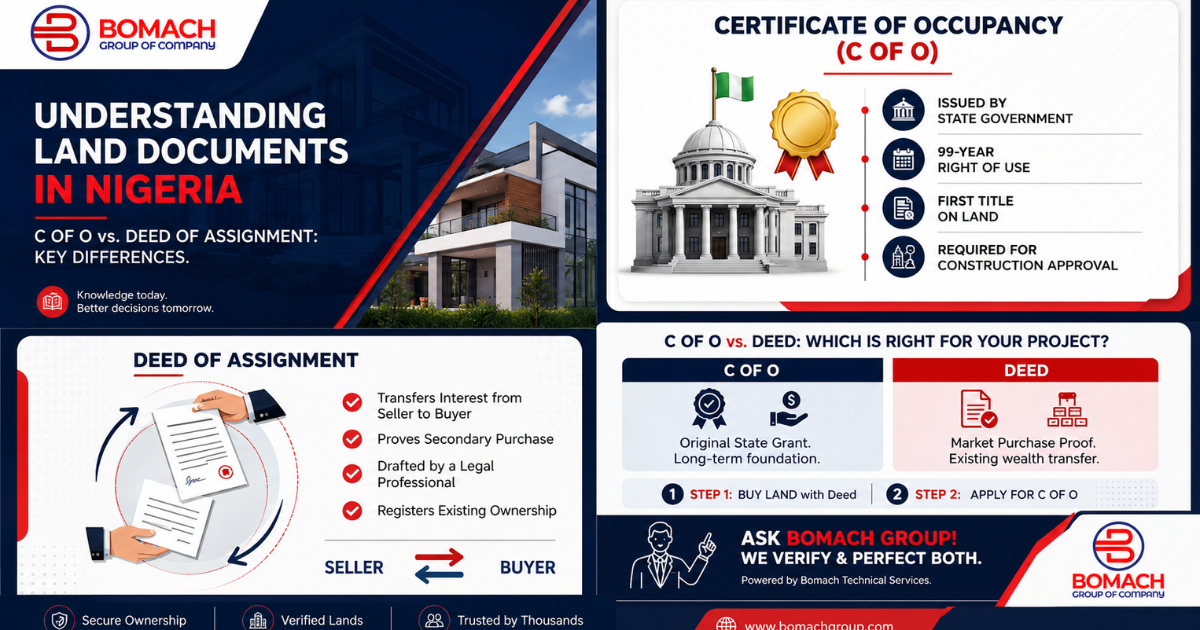
A Certificate of Occupancy, commonly called a C of O, is issued by the relevant government authority as evidence that a person or organisation has been granted or recognised as holding a right of occupancy over a particular parcel of land.
It normally contains information such as:
The name of the holder
The location and size of the property
The approved land use
The duration of the right
Applicable conditions, rents or obligations
The Land Use Act authorises the Governor to issue a Certificate of Occupancy when granting a statutory right of occupancy or recognising qualifying existing interests.
Important C of O warning
A C of O is not automatically proof that the current seller owns the property.
For example, where the name on the C of O belongs to an earlier owner, the current seller must present documents showing every valid transfer from the named holder to the present owner. A buyer should therefore verify both the C of O and the complete chain of title.
A genuine C of O attached to an incomplete, fraudulent, or unperfected chain of transfers can still expose a buyer to risk.
2. Right of Occupancy or Allocation Letter
A Right of Occupancy represents the right granted to a person to occupy and use land under the Land Use Act.
A government allocation letter may be issued when land is allocated to an individual, company, cooperative or organisation. Depending on the state and transaction, the beneficiary may later be required to fulfil specified conditions and process further documentation.
Before relying on an allocation letter, confirm:
That it was genuinely issued by the relevant authority
That the allottee accepted the allocation
That required fees were paid
That development conditions were complied with
That the allocation has not been revoked
That the person selling is the allottee or a valid successor in title
An allocation letter should not be accepted at face value without verification at the relevant government office.
3. Deed of Assignment
The Deed of Assignment is one of the most important documents in a secondary property transaction.
It records the transfer of an existing interest in land from the seller, known as the assignor, to the buyer, known as the assignee.
A professionally prepared Deed of Assignment should ordinarily contain:
The full details of the parties
The history or root of the seller’s title
A clear description of the property
The agreed consideration
The interest being transferred
Representations and warranties by the seller
Indemnity provisions where appropriate
Execution by the parties and witnesses
A survey plan or property description attached as a schedule
The deed should accurately connect the property being sold to the seller’s title documents and survey coordinates. It should also be executed by the correct parties.
For a company-owned property, execution must comply with the company’s authority and applicable corporate requirements. For family land, the transaction should involve the appropriate family head and principal members.
For inherited property, the executors or administrators must have the legal authority to deal with the estate.
A Deed of Assignment records the transfer, but the buyer may still need to obtain consent, stamp and register the instrument to complete the perfection process. (Taiwo Salam & Co. Properties Limited)
4. Governor’s Consent
Under Section 22 of the Land Use Act, the holder of a statutory right of occupancy generally cannot alienate that right by assignment, mortgage, transfer of possession or sublease without the required consent of the Governor. (Laws of Nigeria)
A Certificate of Occupancy is commonly associated with the initial grant or recognition of a right of occupancy. When that interest is subsequently transferred, Governor’s Consent is normally processed to recognise the new transaction.
Governor’s Consent does not mean that a new C of O must be issued after every resale. Instead, the consent is usually endorsed on or attached to the relevant transfer instrument.
Applications may require documents such as:
The executed Deed of Assignment
Survey plan
Application forms and cover letter
Evidence of tax clearance
Evidence of payment of applicable charges
Existing title documents
Ground-rent or land-charge records
Approved building plans for developed properties, where required
The exact requirements, fees and procedures differ between states. (Tope Adebayo LP)
5. Registered Survey Plan
A survey plan is a technical document showing the identity and physical description of a parcel of land.
It normally contains:
Survey coordinates
Boundary measurements
Beacon numbers
Land area
Property location
Surveyor’s name and registration details
Plan number
Date of survey
Survey seal or authentication details
The plan must be prepared by a registered surveyor.
However, a survey plan is not, by itself, proof of ownership. It identifies a parcel of land but does not automatically prove that the person named on it has a valid legal title.
The survey should be charted or verified through the appropriate Surveyor-General’s office to determine whether the property falls within:
A government acquisition
A committed public-purpose area
A previously surveyed property
An excised area
A restricted zone
Another person’s registered interest
The survey coordinates must also correspond with the physical land inspected by the buyer. (amakaekehomes.com)
6. Excision and Gazette
Excision and gazette records are especially relevant in locations where land previously affected by government acquisition has been released to an indigenous family or community.
An excision is the government’s formal release of a defined portion of land from an acquisition.
A gazette is an official government publication that may contain details of the excised area, including its location, boundaries and benefiting community.
Before purchasing land described as “excision” or “gazette land,” verify:
The exact gazette number and publication details
The name of the benefiting community
The coordinates of the excised portion
Whether the land being offered falls within the excised coordinates
Whether the seller is authorised by the benefiting family or community
Whether the excision has been revoked, amended or affected by later government action
A seller showing a gazette that relates to a neighbouring community or a different set of coordinates does not establish ownership of the property being sold.
7. Purchase Receipt
A purchase receipt is evidence that payment was made for the property.
A proper land receipt should contain:
The buyer’s full name
The seller’s full name
The amount paid
The date of payment
A description of the land
The purpose of the payment
The payment balance, where applicable
The signatures of the parties
Company details where the seller is a corporate body
Receipts are important, but a receipt alone is not sufficient proof of valid title.
A person can issue a receipt for land they do not legally own. Buyers must therefore confirm the seller’s title and authority before payment. (Land.ng)
8. Contract of Sale
A Contract of Sale sets out the terms governing the transaction before or during completion.
It is particularly important where:
The buyer is paying by instalments
Completion will take place at a later date
The seller must satisfy conditions before receiving the balance
The buyer is purchasing an off-plan property
Allocation or infrastructure delivery will occur later
Refund, default or termination conditions must be clearly stated
The contract should address:
Purchase price
Payment structure
Completion date
Documents the seller must provide
Possession and allocation
Default consequences
Refund conditions
Taxes and transaction expenses
Dispute-resolution procedure
Parties responsible for perfection
It should be prepared or reviewed by a qualified property lawyer and should not contain terms that allow the seller to change the plot, price or delivery obligations without reasonable protection for the buyer. (Land.ng)
9. Deed of Assent
A Deed of Assent is commonly used when property belonging to a deceased person is transferred by the personal representatives of the estate to a beneficiary.
The seller should provide supporting documents such as:
The deceased owner’s title documents
Death certificate
Grant of Probate, where there is a valid will
Letters of Administration, where the person died intestate
Deed of Assent
Evidence identifying the authorised executors or administrators
A beneficiary who is merely named in a will may not automatically have the authority to sell estate property before the proper probate process has been completed.
10. Grant of Probate and Letters of Administration
A Grant of Probate is issued where a deceased property owner left a valid will, and the named executors have been legally authorised to administer the estate.
Letters of Administration are generally issued where the deceased died without a valid will or where no executor is available to act.
These documents are essential when purchasing inherited property because they help establish who has the legal authority to represent the estate.
Buyers should not rely solely on statements such as:
“I am the first son.”
“The family has agreed.”
“The property was given to me.”
“The owner was my father.”
“All the children know about the sale.”
Family relationship does not automatically equal legal authority to transfer estate property. (Land.ng)
11. Power of Attorney
A Power of Attorney authorises another person to act on behalf of the property owner.
It may permit the appointed person to:
Negotiate a sale
Sign specified documents
Manage the property
Collect rent
Apply for approvals
Complete registration processes
However, a Power of Attorney should not automatically be treated as proof that the person presenting it owns the property.
The document must be examined to determine:
Who granted the authority
Whether the donor had a valid title
The precise powers granted
Whether the authority is still valid
Whether it has been revoked
Whether the donor is alive
Whether the transaction exceeds the powers granted
A Power of Attorney is primarily an instrument of authority. The underlying title must still be verified.
12. Deed of Mortgage or Release of Mortgage
Where a property has been used as security for a loan, a mortgage interest may be registered against it.
Before purchasing such property, determine:
Whether the mortgage is still active
The amount outstanding
Whether the lender has consented to the sale
Whether a deed of release or discharge has been executed
Whether the discharge has been registered
Whether the seller has deposited the original title documents with a lender
A seller’s physical possession of land does not prove that the property is free from a mortgage or other encumbrance.
13. Building Plan Approval
Building plan approval gives regulatory permission for a proposed development. It is not proof of land ownership.
A property may have an approved building plan while the applicant’s title remains disputed. Likewise, a person may have valid title but still require development approval before construction.
Before building, verify:
The approved use of the land
Planning and zoning restrictions
Required setbacks
Building height limitations
Environmental or infrastructure restrictions
Development permits required by the state or local authority
Separating title verification from development approval helps buyers avoid the mistaken belief that an approved plan automatically validates ownership.
The Three Stages of Perfecting a Land Title
After a property transaction has been completed, the buyer may need to perfect the acquired interest.
The commonly recognised stages of title perfection are:
1. Consent
The appropriate consent is obtained for the transfer where the Land Use Act and applicable state procedures require it.
2. Stamping
The transaction instrument is assessed and stamped in accordance with applicable stamp-duty requirements.
3. Registration
The instrument is registered at the appropriate state land registry, creating an official record of the buyer’s interest.
Legal guidance on Nigerian land registration commonly describes perfection as the combination of consent, stamping and registration.
A purchaser who fails to perfect the acquired interest may remain exposed to competing interests and difficulties during resale, mortgage applications or future development. (Tope Adebayo LP)
Because land administration is implemented at the state level, the required forms, fees, processing channels and supporting documents may differ across Lagos, Enugu, Abuja, Rivers, Anambra and other jurisdictions.
How to Verify Land Documents in Nigeria
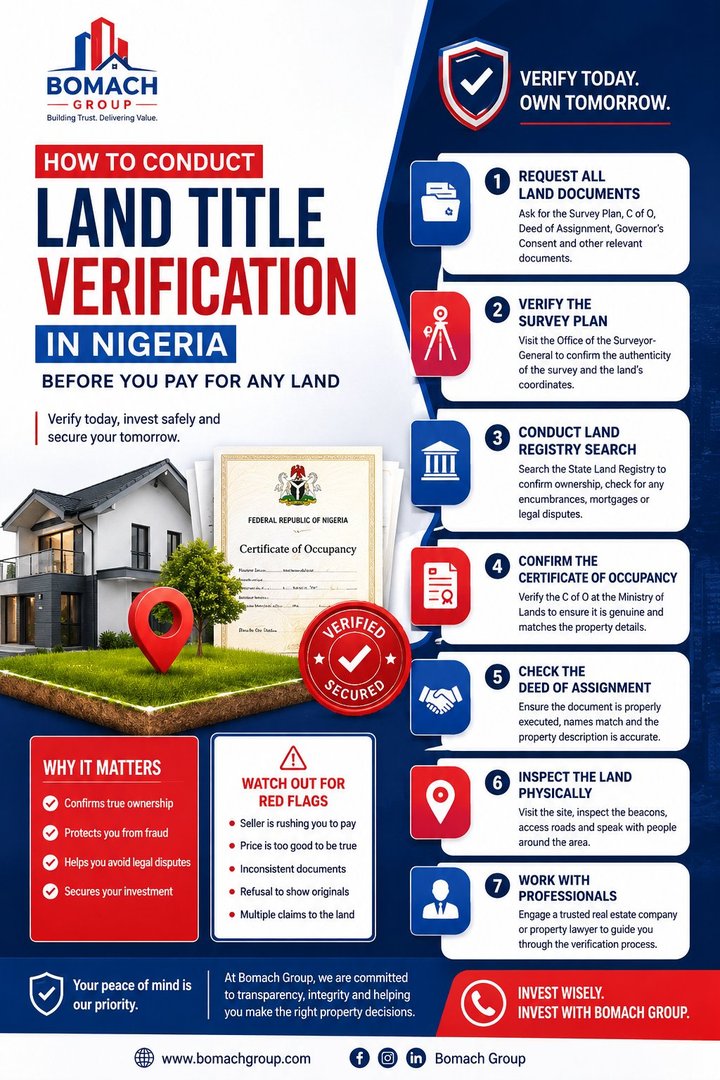
Step 1: Investigate the Seller
Confirm the seller’s identity and legal capacity.
For an individual, examine valid identification and ensure the name corresponds with the title documents.
For a company, conduct a Corporate Affairs Commission search and confirm that the company owns the property and has authorised the transaction.
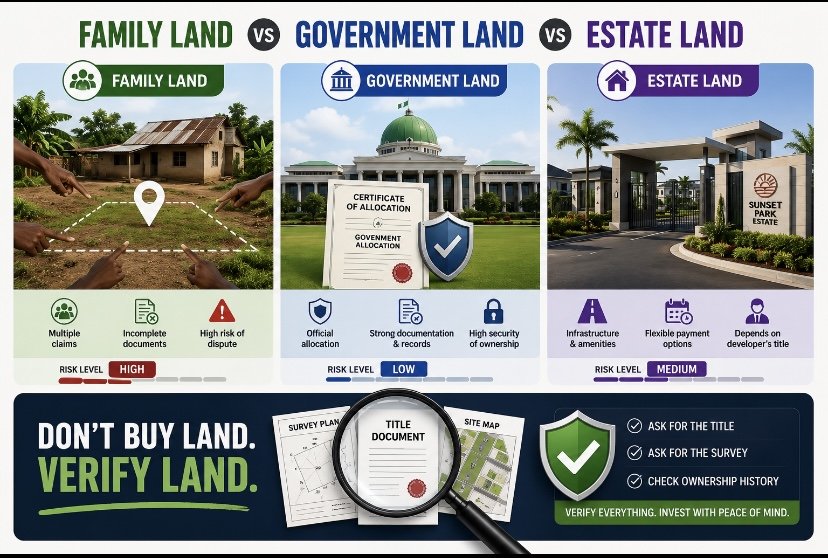
For family land, identify the recognised family head and principal members. Avoid transactions signed by only one family member without evidence of authority.
For inherited property, verify the probate documents and the powers of the executors or administrators.
Step 2: Trace the Root of Title
The root of title explains how the seller or the seller’s predecessor originally acquired the property.
Possible roots include:
Government allocation
Certificate of Occupancy
Customary ownership
Excision and gazette
Purchase from a previous owner
Inheritance
Court judgment
Deed of Assent
Registered conveyance or assignment
Each transfer in the ownership chain must connect logically and legally to the next. Missing links should be investigated rather than explained away verbally.
Step 3: Conduct a Land Registry Search
A search at the relevant land registry can reveal:
The registered owner
Registered assignments
Mortgages
Subleases
Restrictions
Cautions
Court orders
Government interests
Existing encumbrances
The details in the registry should correspond with the documents presented by the seller.
Step 4: Verify the Survey
Engage a registered surveyor to inspect the property and verify its coordinates.
The survey should be charted at the appropriate Surveyor-General’s office to identify government acquisition, overlapping surveys or planning restrictions.
Never verify only the document without confirming that its coordinates relate to the actual land shown during inspection.
Step 5: Conduct a Physical Inspection
A physical inspection can reveal problems that may not appear immediately in the documents, including:
Encroachment
Occupiers or tenants
Multiple claimants
Boundary disputes
Access-road problems
Community restrictions
Flooding or drainage issues
Existing structures
Government markings
High-voltage lines or pipeline setbacks
Speak with adjoining property owners and credible community representatives where appropriate, but do not substitute informal enquiries for professional verification.
Step 6: Search for Litigation and Encumbrances
A buyer’s lawyer should investigate whether the property is subject to:
Pending litigation
Court judgments
Probate disputes
Family disputes
Government acquisition
Mortgage
Tenancy claims
Existing sale agreements
Powers of attorney granted to another person
A seller who refuses to disclose disputes or allow independent verification should be treated as a serious risk.
Step 7: Use Traceable Payments
Payments should be made through traceable channels and supported by proper receipts.
The payment description should identify the property or transaction. Avoid transferring large sums to unrelated third parties without written legal justification.
Where payment is made in stages, the contract should clearly state the outstanding balance, completion conditions and consequences of default.
Step 8: Execute the Correct Documents
The Deed of Assignment, contract, receipt and other transaction documents must carry consistent information.
Check that:
Names are correctly spelled
Plot numbers match
Survey details correspond
Land measurements are consistent
Dates do not conflict
The person signing has authority
Witnesses are properly identified
Company seals or execution requirements are satisfied where applicable
Step 9: Take Possession and Secure the Boundaries
After completion, obtain formal possession and handover evidence.
Depending on the transaction, this may include:
Allocation letter
Possession letter
Handover certificate
Estate allocation plan
Beacon confirmation
Photographs and inspection report
Keys for developed property
Acknowledgment by the seller
The buyer should protect the boundaries and monitor the property against encroachment while avoiding unlawful self-help.
Step 10: Perfect and Preserve the Title
Submit the relevant documents for consent, stamping and registration where applicable.
Keep the original title documents securely and maintain digital copies in encrypted storage.
Also preserve:
Search reports
Survey charting results
Payment records
Correspondence
Inspection reports
Legal opinions
Development approvals
Tax and land-charge records
Good document preservation can become critical many years after the original purchase.
Common Land Documentation Mistakes in Nigeria
Believing a Receipt Is Enough
A receipt proves payment, not necessarily ownership or the seller’s authority.
Assuming Every C of O Is Safe
A document may be forged, revoked, encumbered or unrelated to the parcel inspected.
Failing to Verify the Seller’s Chain of Title
The current seller must show how the interest moved from the original holder to them.
Buying Family Land From One Relative
The person collecting payment may not have the authority to bind the entire family.
Treating a Survey Plan as a Title
A survey identifies land; it does not independently establish ownership.
Skipping Government Acquisition Checks
A property may fall within a committed public-purpose area even when a seller presents receipts and family documents.
Failing to Perfect the Transfer
An executed Deed of Assignment should not be abandoned in a file without completing the applicable consent, stamping and registration processes.
Using the Seller’s Lawyer as the Buyer’s Only Adviser
A buyer should obtain independent legal representation. The seller’s adviser is primarily responsible for protecting the seller’s interests.
Land Documentation Checklist for Nigerian Property Buyers
Before completing any land purchase, confirm that you have reviewed or obtained the applicable documents:
Seller and ownership documents
Valid identification
Root-of-title document
Certificate of Occupancy, allocation or other title evidence
Previous Deeds of Assignment
Family authority or consent where applicable
Probate or administration documents for inherited property
Corporate documents and sale authorisation for company property
Property-identification documents
Survey plan
Survey charting or verification report
Site inspection report
Plot allocation plan
Beacon confirmation
Transaction documents
Contract of Sale
Deed of Assignment
Purchase receipt
Payment records
Possession or handover letter
Allocation letter where applicable
Perfection and regulatory documents
Governor’s Consent where required
Stamp-duty evidence
Registration evidence
Approved building plan
Development permit
Ground-rent and land-charge records
Tax-clearance documents where required
The exact documents needed will depend on the location, history and nature of the property.
Frequently Asked Questions About Land Documentation in Nigeria
What is the most important land document in Nigeria?
There is no single document that should be examined in isolation. A C of O may be important, but the buyer must also confirm the seller’s chain of title, survey details, authority to sell and the validity of subsequent transfers.
Is a Deed of Assignment proof of ownership?
A Deed of Assignment is strong evidence of a transfer, but its effectiveness depends on the seller having a valid interest to transfer. The deed should also be properly executed and perfected where required.
Can I buy land with only a survey plan and receipt?
This is highly risky. The survey identifies the property and the receipt proves payment, but neither document automatically proves that the seller has a valid title.
What is the difference between a C of O and Governor’s Consent?
A C of O generally evidences the grant or recognition of a right of occupancy. Governor’s Consent relates to the subsequent transfer or alienation of an existing statutory right of occupancy where consent is required.
Must every landowner have a C of O?
Not every valid interest begins with a newly issued C of O. Land rights may arise through government allocation, customary ownership, inheritance, registered transfers and other recognised roots. The specific title and perfection requirements depend on the property’s history and jurisdiction.
Can a seller use a Power of Attorney to sell land?
Yes, where the Power of Attorney validly grants the necessary authority and remains legally effective. The buyer must still verify the donor’s ownership and the scope of the attorney’s powers.
Who should verify land documents?
A proper verification team may include:
A property lawyer
A registered surveyor
A qualified estate surveyor or real estate professional
Relevant land-registry and planning authorities
Final Thoughts
The safest property transactions are not built on promises, familiarity or attractive prices.
They are built on a verifiable ownership history, accurate survey information, properly drafted transfer documents and compliance with applicable registration procedures.
Before paying for land in Nigeria, ask four questions:
Who owns it? What exact land is being sold? Does the seller have authority to transfer it? What must be done to protect the buyer’s interest after payment?
At Bomach Group, property documentation is treated as a core part of protecting the client, not as paperwork to be considered after payment.
Buyers should be given clear information about the applicable title, survey documentation, transaction records, and Deed of Assignment, while being encouraged to carry out independent legal and technical verification.
A beautiful location may attract your attention, but proper documentation is what protects the investment.
Thinking about acquiring property? Verify the title, inspect the land and understand the documentation before making payment.
This article is provided for general property education and does not replace advice from a qualified Nigerian property lawyer regarding a particular transaction.